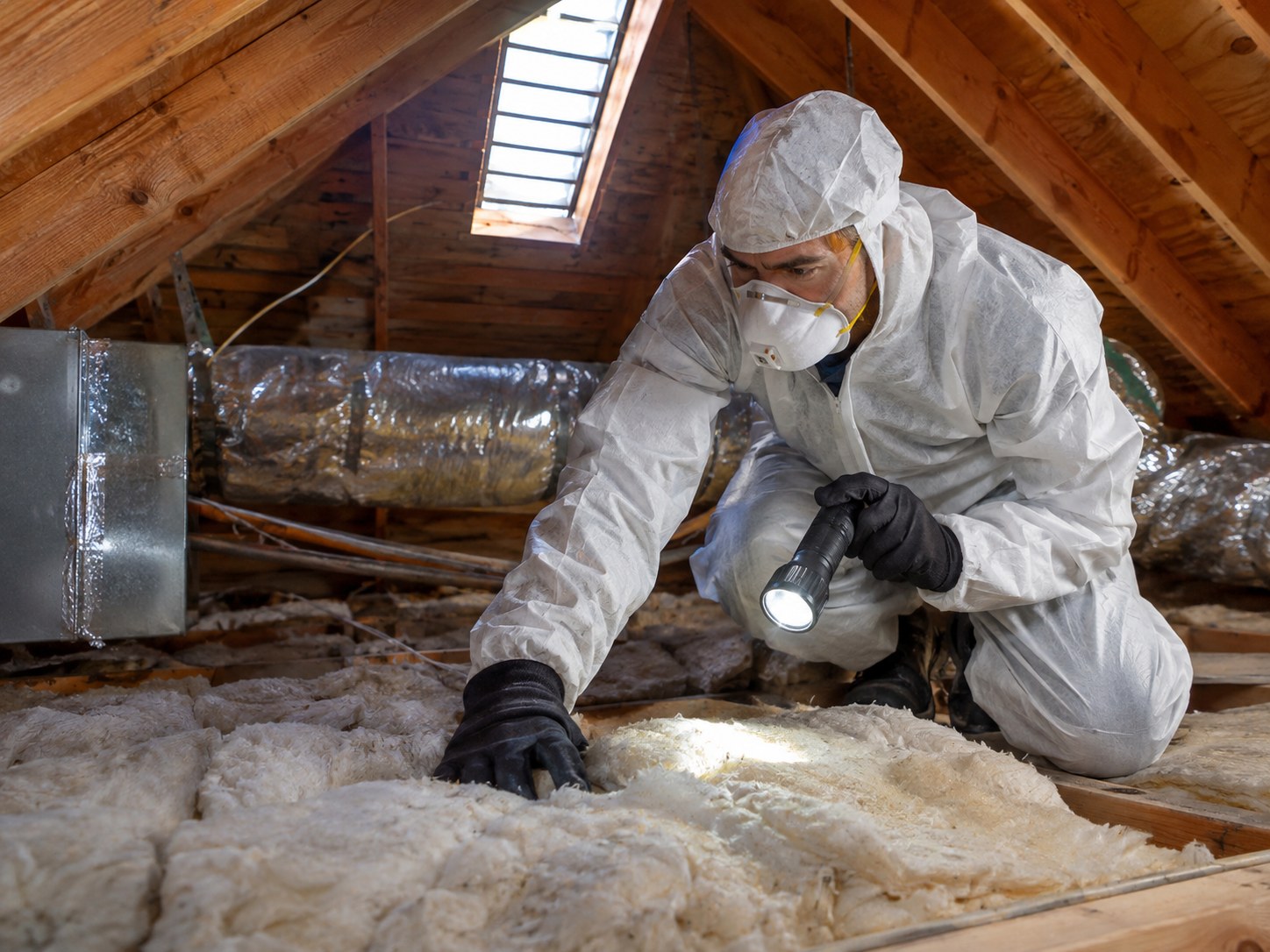
Adding fresh insulation on top of what is already in the attic sounds like the simple fix for a home that runs hot in summer and cold in winter. In a large share of San Fernando Valley and Greater Los Angeles homes, it is the wrong move. Much of the local housing stock was built between the 1950s and the 1980s, and the original attic blanket in those homes has spent four to seven decades settling, absorbing moisture, collecting dust, and in many cases hosting rodents. Layering new material over insulation in that condition traps the problem underneath, where it keeps dragging down comfort and air quality. This is the situation where insulation removal has to come first.
Homeowners across Northridge, Reseda, Van Nuys, and Canoga Park tend to reach for the same web searches when the attic stops doing its job: whether old insulation should be taken out, what insulation removal and replacement involves, and how to tell if the existing material is worth keeping. The honest answer depends on what the attic is hiding. Clean, dry fiberglass batts that have simply flattened a little can sometimes be topped up. Insulation that has been wet, compressed into a dense mat, chewed through by rats, or fouled with droppings has to be removed, because its insulating value is already gone and the contamination will not stay put under a new layer.
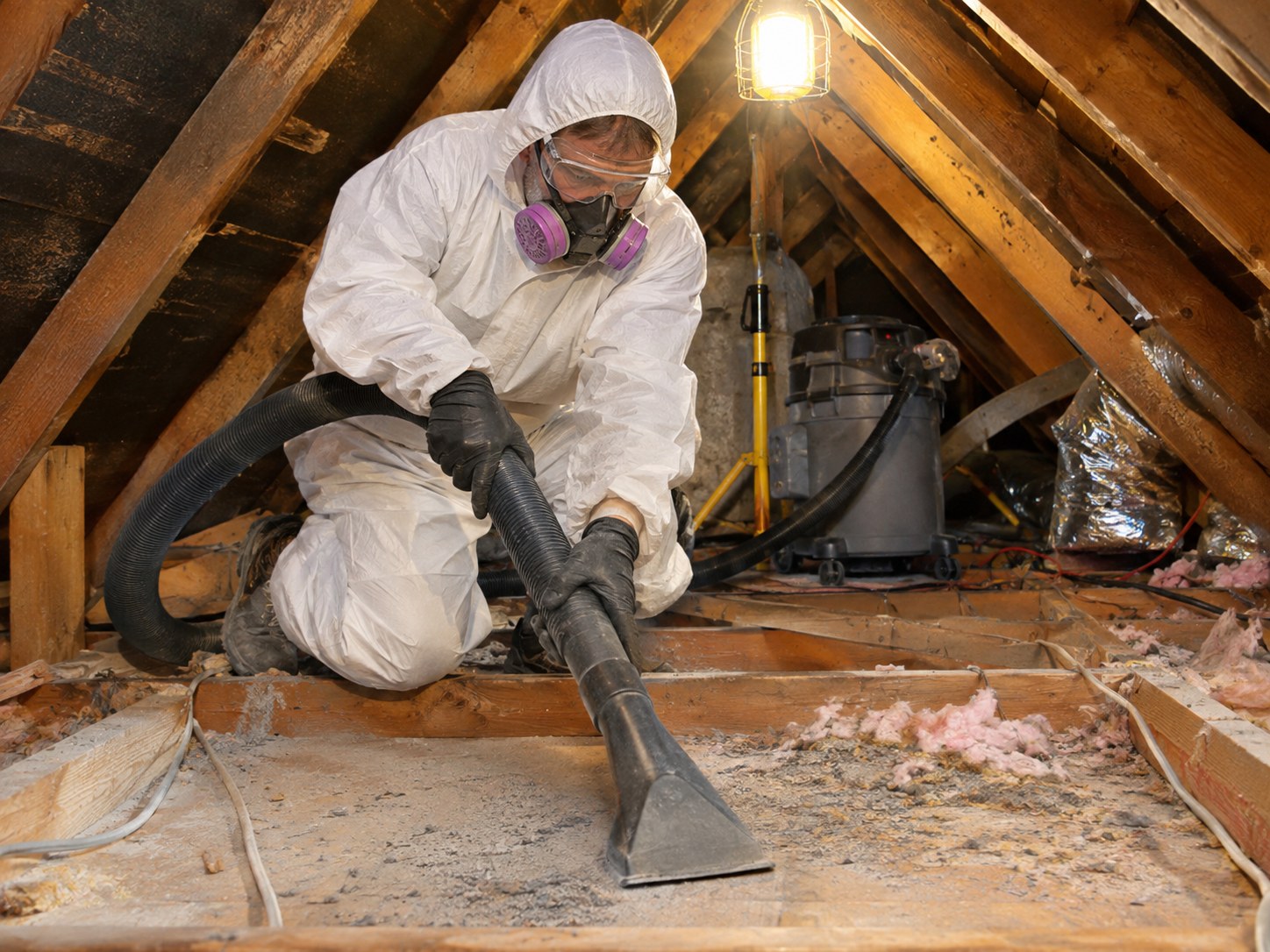
Insulation works by trapping still air in millions of tiny pockets, and anything that collapses those pockets destroys the R-value, the number that measures resistance to heat flow. Blown-in cellulose and fiberglass settle over time, losing loft and thickness. Decades of attic dust sifts down into the fibers. Roof leaks and condensation leave the material damp, and damp insulation both loses performance and becomes a surface where mold can take hold. A blanket that started at R-19 when the house was framed may be performing closer to R-8 or R-11 today, which is far below the Title 24 target for the Los Angeles area.
There is also the question of what moved in. Roof rats, Rattus rattus, are endemic across Los Angeles County, and the older Valley housing stock carries a high infestation rate because original soffit vents, eave vents, and roof penetrations were never re-screened. Once rodents nest in an attic, their droppings, urine, and nesting debris saturate the insulation. No amount of new material laid on top changes the fact that contaminated insulation stays contaminated. In those attics, insulation removal is not optional. It is the only way to reset the space to a clean starting point.
Several conditions push a project firmly into remove-and-replace territory rather than a simple top-up. Water damage is the clearest. If a roof has leaked, even intermittently, the insulation below the leak has likely been wet more than once, and wet cellulose in particular clumps and stays compressed. Rodent activity is the second. Scratching in the ceiling, a musty ammonia odor, or visible droppings all point to contamination that has to come out. Age is the third. Insulation that predates the 1990s has usually lost so much performance that removing it and starting fresh gives a far better result than burying it.
Then there is the category that stops a job cold until it is tested. Homes built before 1980 in Los Angeles sometimes contain vermiculite insulation, a pebble-like material that can hold asbestos fibers. Some older homes also have asbestos in other attic materials. Nobody should disturb that material, and responsible contractors will not touch it until a sample has been tested by a qualified lab. If asbestos is confirmed, the work moves to a licensed abatement specialist who follows controlled removal and disposal rules. This is one of the most important reasons a careful inspection comes before any home insulation removal begins.
Homeowners weighing insulation removal against a quick top-up can run through a few questions before calling anyone. The answers usually make the decision obvious.
A yes to any of the first three almost always means the old material should be removed and replaced rather than covered. A yes to the last two is a strong signal that the insulation has stopped earning its keep. When the answers are all no and the insulation is clean, dry, and simply a little thin, a top-up may be reasonable, and a good contractor will say so rather than selling an unnecessary tear-out.
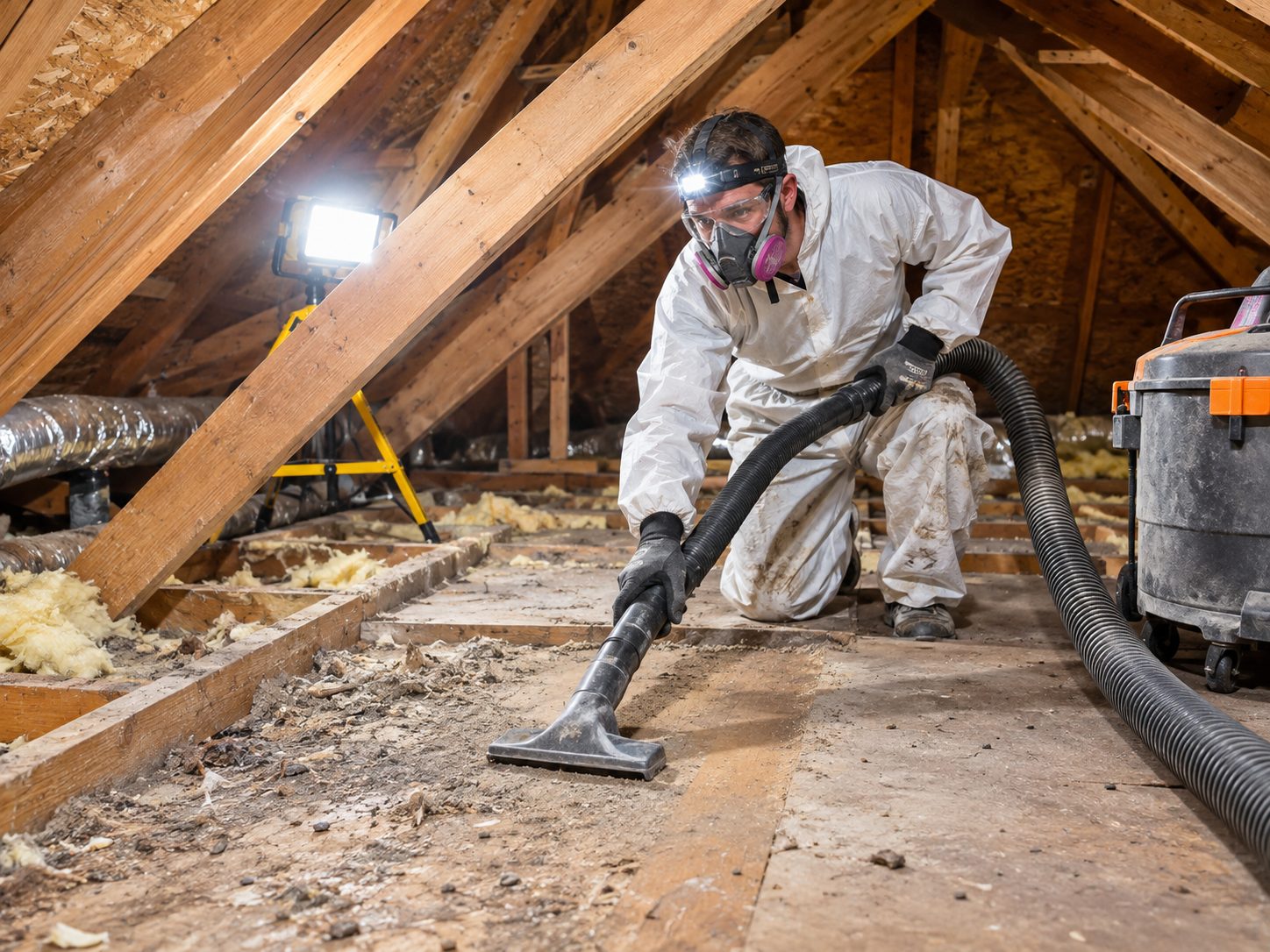
Done properly, attic insulation removal is a contained process, not a dusty free-for-all. A crew protects the living space below, runs a commercial vacuum with long hoses up into the attic, and extracts loose-fill cellulose or fiberglass into sealed bags. Batt insulation is rolled, bagged, and carried out. Where rodents were present, the sequence expands to include removal of droppings and nesting material, sanitizing of the attic surfaces, and deodorizing to deal with lingering smell. The bagged material is hauled away and disposed of according to local rules, and clean attics are left ready for air sealing and new insulation.
The order matters. Removing the old blanket exposes the attic floor, the top plates of the walls, and the many small gaps where conditioned air leaks out of the house, around recessed lights, plumbing stacks, and wiring penetrations. Sealing those gaps while the attic is empty is far easier and far more effective than trying to seal around existing insulation. This is why insulation removal and replacement handled as a single project usually outperforms a top-up: the house gets a clean cavity, a proper air seal, and a full-depth new blanket all at once.
Once the attic is clean and sealed, the replacement insulation can be installed to a depth that actually meets current standards. California Title 24 Part 6 sets energy requirements by climate zone, and most of the Los Angeles basin and the San Fernando Valley fall in Climate Zone 9. For attic retrofits in this area, R-30 is a common minimum, R-38 is a frequent target, and R-49 is used where a homeowner wants higher performance. Hitting those numbers is only possible when the installer starts from a clean attic floor, because settled and contaminated material makes the true depth impossible to judge.
The payoff is comfort and lower run time for the heating and cooling system. Pure Eco Inc. describes attic insulation upgrades as cutting home energy use by as much as 20 percent, a figure that lines up with the general range building scientists cite for bringing an under-insulated attic up to standard. The exact result depends on the home, the climate zone, and how leaky the house was to begin with, so homeowners should treat any single percentage as a ceiling rather than a promise. What is consistent is that a clean, well-sealed, full-depth attic performs far better than a thin or contaminated one, regardless of how much new material is piled on top.
Insulation is also where indoor air quality quietly lives or dies. Dust, rodent allergens, and mold spores in old attic material get pulled into the living space every time the heating or cooling system cycles, because attic air and house air are rarely as separated as homeowners assume. Families in Encino, Sherman Oaks, and Studio City who deal with year-round allergy symptoms sometimes trace part of the problem to an attic that was never cleaned out. Removing the old insulation and sanitizing the space removes that reservoir of irritants, which is a benefit a top-up can never deliver.
None of this means every attic needs a tear-out. It means the decision should be based on what is actually up there, confirmed by a real inspection, not on a sales script or a guess from the hallway. A homeowner who understands when insulation removal is necessary, and when it is not, is in a far stronger position to judge an estimate and avoid paying for work that does not fit the house.
Insulation and attic ventilation are two halves of the same system, and a removal project is the moment to look at both. In many older Valley homes, decades of loose-fill have drifted into the soffit vents at the edges of the attic, choking off the airflow that keeps the space dry and moderates its temperature. When the old material comes out, a crew can clear those vents and install baffles that hold the new insulation back from the eaves, so air moves the way the roof was designed to let it. Layering new insulation over the old blockage simply locks in a ventilation problem that will keep feeding moisture and heat back into the home.
Moisture is the quiet reason ventilation matters so much. A poorly vented attic traps humid air, and over time that moisture settles into the insulation and the framing, where it degrades performance and invites mold. Correcting the airflow while the attic is open is far easier than trying to fix it around an existing blanket. This is one more way insulation removal pays off beyond the insulation itself: it opens a clear view of the whole attic system and a chance to set it right.
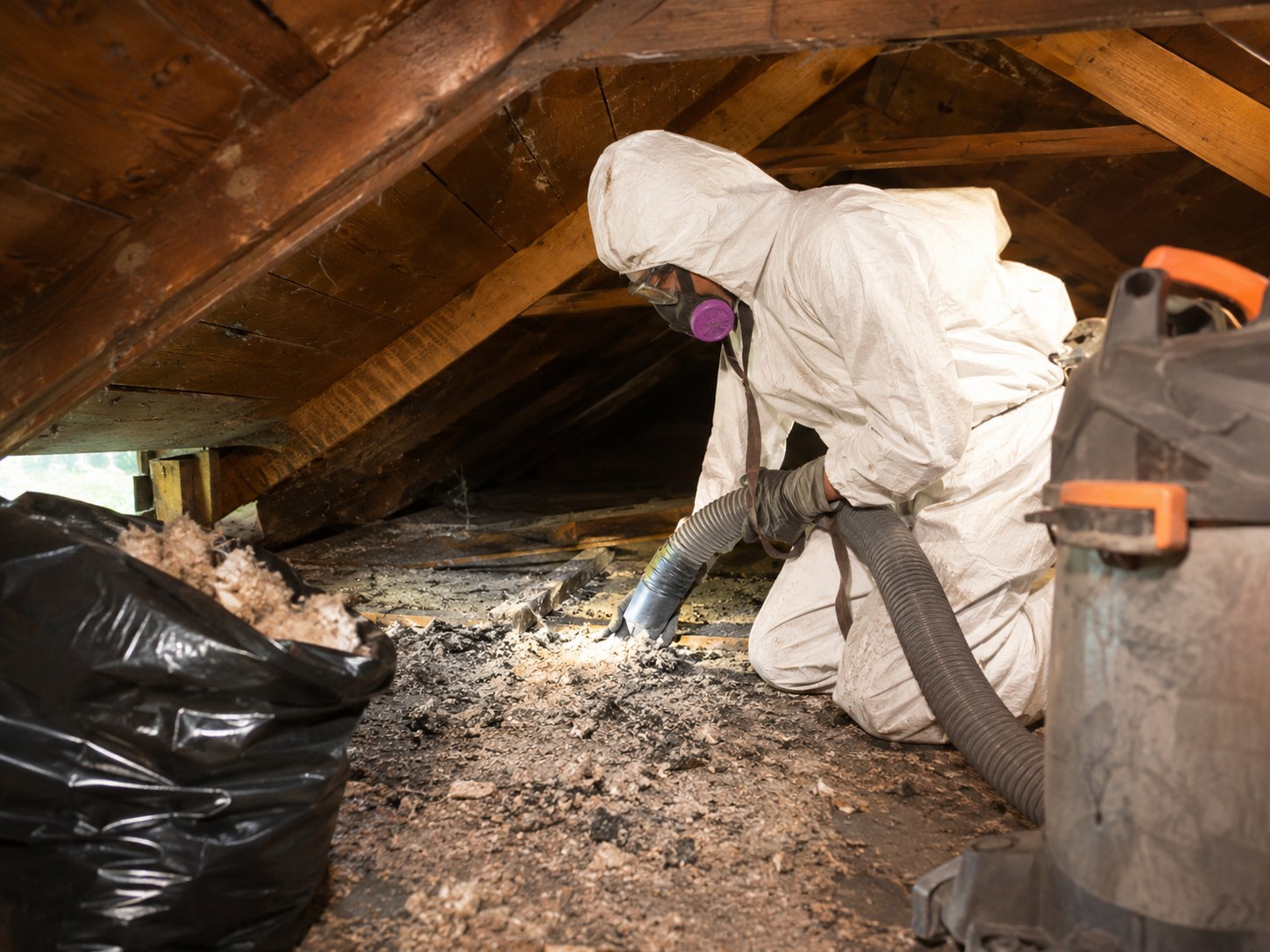
Attic insulation removal looks simple from the hatch and turns difficult fast. Loose-fill cellulose and fiberglass are messy to handle, the fibers irritate skin and lungs, and a household vacuum is no match for the volume of material in a full attic. Without containment, the dust spreads through the house. Disposal is its own problem, since bagged insulation has to go somewhere that accepts it, and contaminated material carries stricter rules. The equipment rental, protective gear, and dump fees often add up to more than a homeowner expects, and none of it addresses the real hazard.
That hazard is what makes the do-it-yourself route risky rather than just tiring. A homeowner who disturbs vermiculite or asbestos in a pre-1980 attic without knowing it can release fibers that are dangerous to the whole household, and a homeowner who dry-vacuums rodent waste can send pathogens into the air. These are the situations where the cost of a professional is not about convenience but about containment and testing that a weekend project cannot provide.
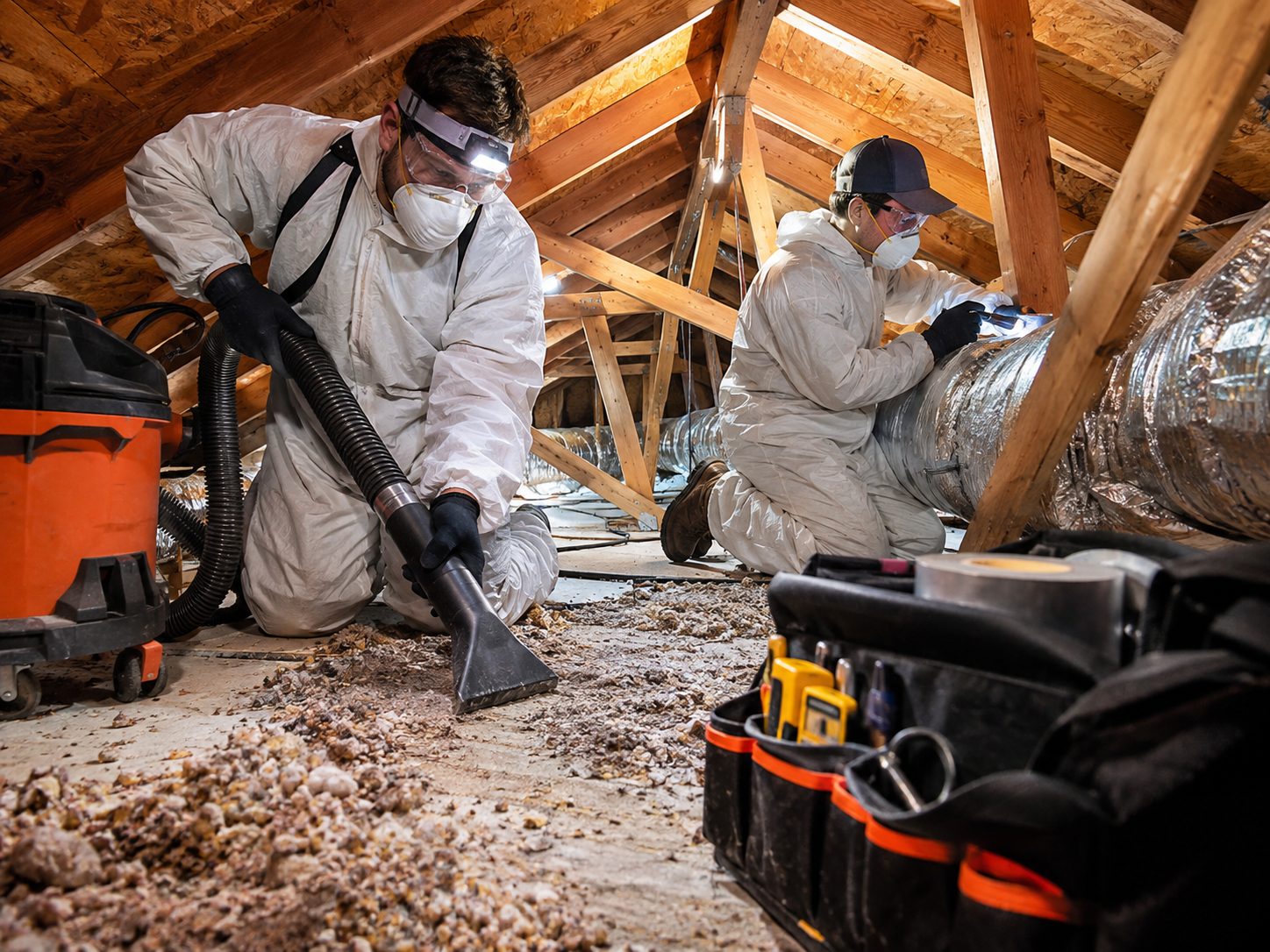
It helps to think of removal as the groundwork rather than a cost to be minimized. A clean attic floor is what makes accurate air sealing possible, what lets a new blanket reach full depth, and what gives the heating and cooling system a fair chance to hold a temperature without running constantly. When a home is sold, a documented attic with clean, code-level insulation also answers one of the questions a buyer's inspector asks, which can smooth a transaction that a contaminated attic would complicate. In each case the value comes from starting clean, which is exactly what a top-up over failed material cannot deliver.
Pure Eco Inc. performs attic insulation removal and replacement across the San Fernando Valley and Greater Los Angeles from its Chatsworth headquarters at 9740 Variel Ave, holding California contractor license number 993589 and more than 20 years of local experience. A free home assessment with a written estimate is available at (877) 870-7998. Homeowners researching insulation removal and replacement for a Los Angeles home can find more information at https://www.pureecoinc.com/insulation-removal/.
|
Chatsworth
|
|
|---|---|

Chatsworth neighborhood as mapped by the Los Angeles Times
|
|
|
Location within Los Angeles/San Fernando Valley
|
|
| Coordinates: 34°15′26″N 118°36′04″W / 34.25722°N 118.60111°W | |
| Country | United States |
| State | California |
| County | Los Angeles |
| City | Los Angeles |
| Named for | Chatsworth House, Derbyshire, England |
| Elevation
|
978 ft (298 m) |
| Population
(2000)[1]
|
|
|
• Total
|
41,255 |
| Time zone | UTC-8 (PST) |
| • Summer (DST) | UTC-7 (PDT) |
| ZIP code |
91311
|
| Area codes | 747 and 818 |
Chatsworth is a suburban neighborhood in Los Angeles, California, in the San Fernando Valley. The area around the town was home to Native Americans, who left caves containing rock art. Chatsworth was discovered and settled by the Spanish beginning in the 18th century. The land was part of a Spanish land grant, Rancho Ex-Mission San Fernando. After the United States purchased the land following the Mexican–American War, it was the largest such grant in California. Chatsworth has seven public and eight private schools. There are large open-space and smaller recreational parks as well as a public library and a transportation center. Landmarks in the town include the former Chatsworth Reservoir and the Santa Susana Field Laboratory. The neighborhood has one of the lowest population densities in Los Angeles and a relatively high income level. Chatsworth is the home of the Iverson Movie Ranch, a 500-acre (202-hectare) area which was the most filmed movie ranch in history, as more than 2,000 productions used it as a filming location.
 |
This section needs to be updated. (January 2025)
|
The 2000 U.S. census counted 35,073 residents in the 15.2 square miles (39 km2) Chatsworth neighborhood, or 2,301 people per square mile, among the lowest population densities for both the city and the county. In 2008, the city estimated that the population had increased to 37,102. In 2000, the median age for residents was 40, considered old for city and county neighborhoods; the percentages of residents aged 35 and older were among the county's highest.[2]
The neighborhood was considered to be ethnically "moderately diverse" for both the city of Los Angeles and its county, with a relatively high percentage of whites and Asian people, and a sizable Hispanic/Latino community. The population was 65.7% Non-Hispanic White, 14.4% Asian, 13.5% Hispanic or Latin, 2.2% Black, and 4.2% of other origins. Among the 25.2% of residents born abroad - a low figure for Los Angeles - Korea (10.4%) and the Philippines (9.3%) were the most common places of birth.[2]
The median yearly household income in 2008 dollars was $84,456, considered to be a high income for the city. The percentages of families that earned more than $40,000 was considered high for the county. Renters occupied 28.9% of the housing stock, and house- or apartment-owners held 71.1%. The average household size of 2.6 people was considered average for Los Angeles.[2]
In 2000, there were 2,933 military veterans, or 10.8% of the population, a high percentage compared to the rest of the city. The percentage of married people was among the county's highest. The rate of 10% of families headed by single parents was low for the city.[2]
Chatsworth is flanked by the Santa Susana Mountains on the north, Porter Ranch and Northridge on the east, Winnetka, Canoga Park, West Hills on the south, the Simi Hills, and unincorporated Los Angeles County and Ventura County on the west, and Twin Lakes, a community founded by San Francisco's George Haight in the early 20th century and unincorporated Los Angeles County which includes a 1,600-acre park with equestrian trails, to the north.[3][4]
This region experiences hot and dry summers, with average daily high temperatures of 90–100 °F. According to the Köppen Climate Classification system, Chatsworth has a Mediterranean climate.[5]
| Climate data for Chatsworth (Heynemann), Los Angeles, California, US | |||||||||||||
|---|---|---|---|---|---|---|---|---|---|---|---|---|---|
| Month | Jan | Feb | Mar | Apr | May | Jun | Jul | Aug | Sep | Oct | Nov | Dec | Year |
| Record high °F (°C) | 84 (28.9) |
85 (29.4) |
92 (33.3) |
99 (37.2) |
105 (40.6) |
101 (38.3) |
105 (40.6) |
106 (41.1) |
108 (42.2) |
104 (40.0) |
90 (32.2) |
82 (27.8) |
108 (42.2) |
| Mean daily maximum °F (°C) | 66.8 (19.3) |
70.4 (21.3) |
71.7 (22.0) |
78.1 (25.6) |
79.6 (26.4) |
86.9 (30.5) |
96.6 (35.9) |
93.2 (34.0) |
95.0 (35.0) |
80.9 (27.2) |
70.8 (21.6) |
65.4 (18.5) |
79.6 (26.4) |
| Mean daily minimum °F (°C) | 37.4 (3.0) |
38.0 (3.3) |
43.3 (6.3) |
47.1 (8.4) |
49.3 (9.6) |
52.2 (11.2) |
55.1 (12.8) |
53.8 (12.1) |
54.9 (12.7) |
48.1 (9.0) |
41.6 (5.3) |
41.4 (5.2) |
46.8 (8.2) |
| Record low °F (°C) | 29 (−1.7) |
28 (−2.2) |
32 (0.0) |
37 (2.8) |
37 (2.8) |
43 (6.1) |
47 (8.3) |
47 (8.3) |
43 (6.1) |
39 (3.9) |
31 (−0.6) |
28 (−2.2) |
28 (−2.2) |
| Average precipitation inches (mm) | 3.94 (100) |
2.15 (55) |
2.46 (63) |
1.38 (35) |
0.49 (13) |
0.04 (1) |
0.0 (0) |
0.03 (1) |
0.05 (1) |
0.33 (8) |
1.72 (44) |
3.04 (77) |
15.63 (398) |
| Source: NOAA NCEI (COOP Station USC00041679 / NCDCSTNID 20001814, "Chatsworth Heynemann"; period of record November 1945 – August 1959) | |||||||||||||
Chatsworth was inhabited by the Tongva, Chumash, and Tataviam. They inhabited the valley for an estimated 8,000 years. Stoney Point is the site of the Tongva village of Momonga, which was also a trading place with the neighboring Tataviam and Chumash people.[6] The nearby Burro Flats Painted Cave remains a legacy of the Chumash culture's rock art and solstice ceremony spirituality.[7]
The first European explorers came into the Chatsworth area on August 5, 1769, led by the Spanish military leader Gaspar de Portolà. With its establishment in 1797 and subsequent Spanish Land Grant by the King of Spain, Mission San Fernando (Mission San Fernando Rey de España) gained dominion over the San Fernando Valley's lands, including future Chatsworth.

The Native American trail that had existed from the Tongva-Tatavium village called rancheria Santa Susana (Chatsworth) to another village, replaced by Mission San Fernando, became the route for missionaries and other Spanish travel up and down California. It was part of the El Camino del Santa Susana y Simi trail that connected the Valley's Mission, Los Angeles pueblo (town), and the southern missions with the Mission San Buenaventura, the Presidio of Monterey, and the northward missions. The trail crossed over the Santa Susana Pass to the Simi Valley, through present day city park Chatsworth Park South and the Santa Susana Pass State Historic Park. In 1795, the Spanish land grant had been issued for Rancho Simi, reconfirmed in 1842 by the Mexican governor.[8][9][10] Its lands included part of current Chatsworth, westward from Andora Avenue.
In 1821, after the Mexican War of Independence from Spain, the Mission San Fernando became part of Alta California, Mexico. In 1834, the Mexican government began redistributing the mission lands. In 1846, the Mexican land grant for Rancho Ex-Mission San Fernando was issued by Governor Pío Pico. It was bounded on the north by Rancho San Francisco and the Santa Susana Mountains, on the west by the Simi Hills, on the east by Rancho Tujunga, and on the south by the Montañas de Portesuelo (Santa Monica Mountains). The Rancho Ex-Mission San Fernando received a Federal land patent to retain ownership by the United States Public Land Commission in 1873 and was the single largest land grant in California.[11]
The Chatsworth Historical Society was formed in 1963 in an effort to successfully save the historic Pioneer Church from demolition. The society and Chatsworth Museum are located in Chatsworth Park South at Los Angeles Cultural Historical Monument No. 133, the Homestead Acre . In addition to preserving Chatsworth history and educating the public, the society acts as conservator of the Homestead Acre.[12]

In 1869, the grantee's son, Eulogio F. de Celis, returned from Spain to Los Angeles.[13] In 1874, the family sold their northern half of Rancho Ex-Mission San Fernando to northern Californians, California State Senator Charles Maclay and his partners George K. Porter, a San Francisco shoe manufacturer, and his cousin Benjamin F. Porter. The Porters' land was west of present-day Sepulveda Boulevard including most of Chatsworth, and the Maclay land was east of Sepulveda Boulevard.[14]
The Old Santa Susana Stage Road or Santa Susana Wagon Road continued in use as an alternative to the route along El Camino Viejo from 1861 to 1875, replacing the older road as the main route between Los Angeles and San Francisco. The downgrade from the Santa Susana Pass into Chatsworth was known as "The Devil's Slide". A new wagon route bypassing the deteriorating Devil's Slide was opened in 1895. Initially called El Camino Nuevo (the New Road), it was later named the Chatsworth Grade Road, which continued in use until Santa Susana Pass Road (now Old Santa Susana Pass Road) was built in 1917. In 1876, the Southern Pacific Railroad opened a tunnel through the Newhall Pass, enabling rail connections from Los Angeles north to San Francisco, and rail travel soon replaced travel by stagecoach between Los Angeles and San Francisco. From this time, the stagecoach traffic to Santa Barbara once again used the coast route, and the Santa Susana Pass road was relegated to local traffic.[15] Construction of the 118 Ronald Reagan Freeway through the Santa Susana Pass began in 1968 with major traffic now bypassing Santa Susana Pass Road.[16]
The Chatsworth name, which hails from the stately Chatsworth House in Derbyshire, England, was first recorded in 1888, when George R. Crow filed with the Los Angeles County Recorder's Office a map of the San Fernando Valley with a subdivision he called "Chatsworth Park". William Booth Barber, the president of the San Fernando Valley Improvement Company, was born in England 17 miles from the Duke of Devonshire's palatial estate, Chatsworth House. In 1893 W.B. Barber filed an additional map with the Recorder's Office called the "Plat of Chatsworth Park Townsite".[17]
The Chatsworth Branch Library, operated by the Los Angeles Public Library, is located at 21052 Devonshire Street.[18] It was rebuilt in a modern style in 2002.[19]
The Chatsworth Post Office, of the United States Postal Service, is located at 21606 Devonshire Street.[20]
Los Angeles Animal Services operates the West Valley animal shelter in Chatsworth.[21]
The U.S. Census Bureau operates the Los Angeles Regional Census Center in Chatsworth.[22][23]
The Chatsworth Transportation Center, a major transportation hub for the town and west valley, is served by 20 daily trains on the Metrolink Ventura County Line from Ventura to Union Station in Downtown Los Angeles. Amtrak California Pacific Surfliner has 10 trains daily traveling through here[24] on the Coast Line which also handles freight transport by Union Pacific Railroad and was involved in the 2008 Chatsworth train collision near here.
The Orange Line of the Los Angeles Metro system was extended to Chatsworth Station in 2012, with a dedicated right-of-way across the Valley to North Hollywood Station of the Red Line subway.[25][26][27]
The Chatsworth Transportation Center also offers connections to several Los Angeles Metro, Simi Valley, and Santa Clarita bus routes. It is located at 10046 Old Depot Plaza Road, between Devonshire and Lassen streets.[28]
Chatsworth is serviced by the 118 freeway in the northern end of the neighborhood.
Thirty-four percent of Chatsworth residents aged 25 and older had earned a four-year degree by 2000, an average percentage for the city.[2]
Schools within the Chatsworth boundaries are:[29]

The City of Los Angeles Parks and Recreation Department, California Department of Parks and Recreation, County of Los Angeles, California State Park Volunteers, and the Santa Monica Mountains Conservancy operate the various natural open space preserve parks and neighborhood recreation parks.


A distinctive feature in Chatsworth is the Chatsworth Dam and reservoir. Built in 1918 as part of the Los Angeles Aqueduct system, the property belongs to the Los Angeles Department of Water and Power. Due to increasing concerns of the water quality because of algae plumes and storm water inflow, it was taken out of service in August 1969. After the 1971 San Fernando earthquake additional concerns for seismic safety led to its abandonment by the LADWP as a storage facility.[50] Chatsworth Oaks Park and the Chatsworth Nature Preserve are located here giving views of migrating birds and other animals, and their sounds such as the coyotes calling in the evening. The views of the rocky and dramatic Simi Hills surround the open space.[51]
Chatsworth Reservoir is classified by the Los Angeles Times as a city neighborhood, but "because there are relatively few homes in this area," the Times does not provide separate statistics for it, but adds them to Chatsworth.[52] The Devonshire and Topanga stations of the Los Angeles Police Department provide services in the area.[53]
Chatsworth is the home of the National Notary Association and the headquarters for Premier America (formerly Litton Federal Credit Union) and Matadors Community Credit Union.
The Santa Susana Field Laboratory (SSFL), once busy with Rocketdyne testing rocket engines and Atomics International doing nuclear research, is high in the Simi Hills west of Chatsworth.[54] It has been closed and will undergo an extensive environmental cleanup, andsoon become an open-space park.[55] The park will permanently add to Chatsworth's scenic backdrop, greenway, and hiking opportunities.[56]
Some of the current large employers based in Chatsworth are Capstone Turbine, Natel Engineering, and Hydraulics International. Lamps Plus has production and distribution facilities in Chatsworth.
Titus Software's United States subsidiary once had its headquarters in Chatsworth.[57]
Seltzer Motor Industries, of Chatsworth, in 1979 produced the Willow, a two-seat sports car kit. It is the first transverse, inline four-cylinder, mid-engined kit car ever offered to the public.[58]
20655 Plummer St. Chatsworth, CA 91311
cite web: CS1 maint: deprecated archival service (link)

|
Places adjacent to Chatsworth, Los Angeles
|
|
|---|---|
| International | |
|---|---|
| National | |
| Geographic | |
| Other | |
34°15′26″N 118°36′01″W / 34.25722°N 118.60028°W


